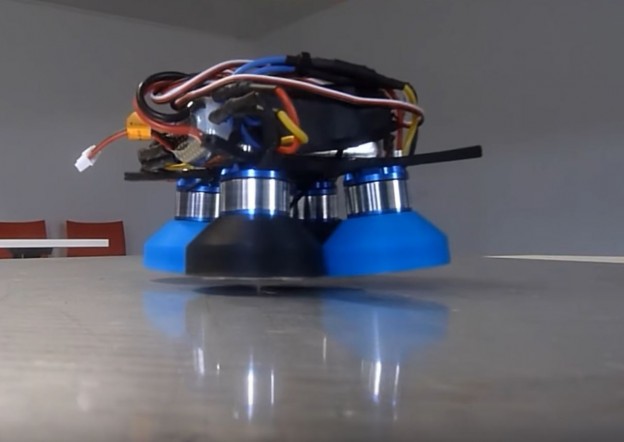
Hoverbot – Spinning magnet inductive hovercraft
Hoverbot was part of a wider project to build a full size hoverboard.
Alas the full scale project ended up too big in terms of money and effort to ever complete, but the small scale hovering test vehicles were interesting in themselves
Rotors carrying neodymium magnets, spun by brushless motors, generate eddy currents in the aluminium sheet below that repel the magnets and cause the units to hover. This would work at full human carrying scale too (with about 10kW electrical system and £2000 worth of magnets) as the independently developed Hendo hoverboard demonstrated. Alas we ran out of impetus with the £3k total price tag and called it a day for the large system 

Sitting lopsided in tethered test due to dodgy motor
The ESCs we used weren’t very good at maintaining speed under changing load, and one of the supposedly identical motors ran slower than the others, so we never got this controllable. In this tethered test, the near left blue rotor is clearly running lower despite the other motors being backed off to compensate. If this motor was better the ride height would definitely be improved. Who knows, we might go back to it one day with governor mode ESCs and better motors…
Hello and sorry for disturb. I would like to experiment this lévitation and I already start my halbach wheel, I already have a répulsion. But may I ask some technical details ? In order to win times, it’s for myself, it’s like a personal challenge, but you can really help me if you reply at one or the things. Many thanks for your reply.
Hi there! I am looking to build a drone similar to the Hoverbot. I was wondering if you could share with me some resources?
Hello, apologies for the delay, our spam filter doesn’t pick notify us of waiting messages, and I’ve not checked for a long while. With regards to the eddy current levitation technology, we found very little published research – we genuinely thought it might have been a new discovery or invention when we set out. We have since seen Hendo (independently working on the same concept at the same time) go public and a few other pre existing similar things, but no good analysis. I would add this is a very challenging area because the scientific notation around magnetism is driven by Maxwell’s electromagnetic work, and permanent magnets take a bit of complex modelling to deliver magnetic flux numbers. Worse the moving eddy current situation is complex and nonlinear, and requires significant multiphysics modelling capability to model (think Comsol, not FEM). As such we explored the space empirically. As the project is 12 years old I don’t think we have this data anymore (I’ve had a hard drive fail in the intervening time). Sorry to not be more help.